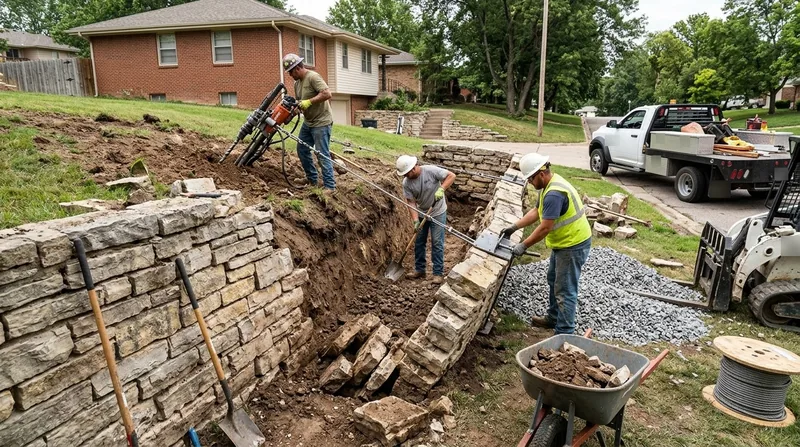




Leaning & Collapsed Wall Repair in Wichita: When the Ground Moves and the Wall Follows
Wichita sits on the broad Arkansas River plain where the Little Arkansas joins it, and that geography writes the story of most wall failures here. Sandy river soil near the water, expansive clay on the uplands, and gentle rises toward the Flint Hills mean walls get pushed, pulled, and heaved by soil that swells after a storm and shrinks in a dry spell. If you are searching for Leaning & Collapsed Wall Repair in Wichita, you already know the look: a block course kicked out at the top, a poured wall cracked along the middle, or a timber wall that has slumped into the bed it was holding. We respond to those calls first, because a leaning wall is a structural warning, not a cosmetic issue. Our work starts with finding the water and the soil movement behind the wall, then stabilizing or rebuilding the wall so it stays put. For walls that are still standing but showing early warning signs, see our retaining wall repair service.
Why Walls Fail in Wichita: Expansive Clay, Flash Floods, and Freeze-Thaw
Most leaning and collapsed walls in Wichita fail for one reason: water gets behind the wall and the soil does not let it go. The expansive clay common on the east side and in newer subdivisions swells hard after a spring storm, pushing with thousands of pounds of lateral pressure, then shrinks in a July drought and leaves voids the wall settles into. Add flash flooding along Gypsum Creek and Chisholm Creek, freeze-thaw swings that work open every joint, and hard Kansas sun baking the face, and a wall that was fine for fifteen years can rotate in one wet season. The dominant failure mode here is hydrostatic pressure combined with clay heave, not coastal-style salt or constant moisture.
- Clay backfill swells and pushes the wall face outward after heavy rain.
- Missing or clogged drainage releases water pressure directly against the block or concrete.
- Freeze-thaw cycles open joints and let water into the wall core.
- Tree roots and creek-bank erosion undercut the footing on sloped lots.
- Aging railroad tie and timber walls rot at the soil line and lose their hold.
When you see any of these, get an inspection before the wall moves another inch.
Key info: A segmental block wall in a newer east Wichita subdivision bulged six inches after a May storm because the original builder backfilled with clay and skipped a drainage gravel zone. We relieved the pressure, reset the top courses, and added proper drainage before the wall could collapse onto the patio below.
Permits and code requirements vary by jurisdiction, and many Wichita-area jurisdictions require a permit for walls above roughly 4 feet measured from the footing or when the wall supports a surcharge such as a driveway or structure. Always verify with the local building department before work begins. You can review general guidance through the City of Wichita offices.
How We Repair a Leaning or Collapsed Wall in Wichita
We do not guess at a wall failure. Every job starts with a walk of the site to read the soil, the slope, the drainage path, and what the wall is holding back. From there we choose stabilization, drainage correction, or a partial or full rebuild, and we tell you which one the wall actually needs. The steps below are the sequence we follow on most leaning and collapsed wall calls in Wichita.
- We inspect the wall, footing, and backfill to find the source of the movement.
- We relieve hydrostatic pressure by correcting or installing drainage behind the wall.
- We stabilize leaning sections with tieback anchors where the wall can be saved.
- We remove and rebuild collapsed sections with proper base, block, and gravel backfill.
- We compact, grade, and restore the surface so water runs away from the wall.
Every repair ends with a drainage check, because a wall without drainage will fail again.
Key info: On a walkout basement lot in Andover, a poured concrete wall had cracked and tipped toward the patio. We stabilized it with tieback anchors and corrected the downspout and grading that had been dumping roof water behind the wall for years. The homeowner kept the wall and avoided a full replacement.
If the wall is beyond saving, we move to full replacement, which you can review on our retaining wall replacement page.
Repair Methods We Use on Wichita Walls
The right method depends on how far the wall has moved, what it is made of, and what it is holding back. We match the approach to the wall, not the other way around.
| Approach | Description | Best for |
|---|---|---|
| Tieback anchoring | Anchors driven into stable soil pull the wall back and hold it against clay pressure. | Leaning block or concrete walls that are still structurally sound. |
| Drainage correction | We install gravel, perforated pipe, and outlet to relieve hydrostatic pressure. | Walls bulging after storms with wet soil behind them. |
| Partial rebuild | We remove and reset the failed section on a proper base with new backfill. | Collapsed corners and sections on otherwise serviceable walls. |
| Full rebuild | We tear out the failed wall and rebuild from the footing up. | Walls that have rotated past saving or lost their footing. |
| Timber wall replacement | We replace rotted railroad tie and timber walls with a durable system. | Aging timber walls slumping at the soil line. |
We choose the least invasive method that will actually hold the wall long term.
Leaning & Collapsed Wall Repair Cost in Wichita: What to Expect
Leaning and collapsed wall repair in Wichita starts at $2,500 for smaller stabilization and drainage jobs, and the number climbs from there based on wall length, height, material, and access. A short block wall with a drainage fix sits near the bottom of that range, while a tall poured concrete wall on a walkout basement lot with limited equipment access runs well above it. The biggest cost drivers are the length and height of the failed section, how much soil has to be removed and replaced, whether tieback anchors are needed, and how close the wall sits to a structure, driveway, or property line.
We recommend getting two or three estimates on any leaning or collapsed wall, because the diagnosis matters as much as the price. A contractor who quotes a rebuild without addressing drainage is quoting a wall that will fail again. Our full pricing breakdown is on the pricing page.
Leaning & Collapsed Wall Repair Near Me: How to Choose a Contractor Near Wichita
When a wall is leaning, you need a contractor who can read the failure and stand behind the repair, not just the lowest bid. Use the checklist below before you sign anything.
- Confirm the contractor is fully insured and ask for a certificate of insurance.
- Get at least two or three written estimates so you can compare scope, not just price.
- Ask for references from recent wall repairs in Wichita and nearby cities like Derby or Maize.
- Ask who pulls the permit and whether engineered drawings are required for your wall height.
- Check HOA rules and property-line setbacks before any rebuild begins.
A contractor who answers these questions clearly is a contractor who will still be around if the wall needs a call-back.
Ready to get a wall looked at? Contact us through the contact page or call (316) 243-1027.
Leaning & Collapsed Wall Repair in Wichita: Pricing Guide
| Service | Price | Details |
|---|---|---|
| Drainage correction and minor stabilization | Starting at $2,500 | Includes pressure relief, gravel and pipe drainage, and resetting a short leaning section. |
| Tieback anchor stabilization | Starting at $4,200 | Anchors and wall pull-back for a leaning wall that is still structurally sound. |
| Partial rebuild of a collapsed section | Starting at $5,500 | Removal and rebuild of the failed run with new base, block, and backfill. |
| Full wall rebuild or replacement | On estimate | Scope depends on wall length, height, material, and access, so we look on site first. |
| Travel | Included | In Wichita and surrounding areas, no separate call-out or mileage fee. |
| Estimate | Free | Response within 24h at (316) 243-1027, no obligation to book. |
Indicative pricing, the exact cost depends on square footage, finish, and site access. Free personalized estimate within 24h at (316) 243-1027.


