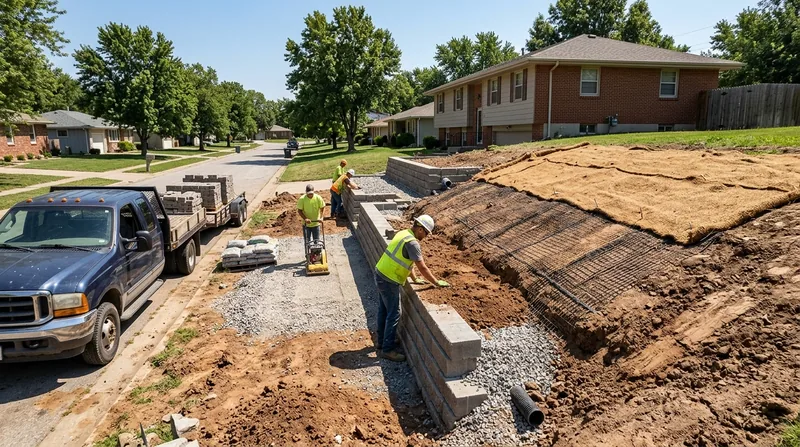




Slope Stabilization & Erosion Control in Wichita: Built for Clay, Creeks, and Kansas Weather
Wichita sits on the broad Arkansas River plain where the Little Arkansas joins it, and that geography drives most of the slope problems we see. Sandy river soil sits near the water, expansive clay covers the uplands, and the ground rises gently toward the east where the Flint Hills begin. That clay swells after a storm and shrinks in drought, so banks creep, swales wash out, and walkout lots lose grade year after year.
Slope Stabilization & Erosion Control in Wichita means stopping that movement before it reaches a foundation, a driveway, or a creek-side patio. We build terraced walls, set geogrid reinforcement, and install drainage that moves water away from the slope instead of through it. If your wall is already leaning or bulging, start with leaning and collapsed wall repair before the slope work begins.
Why Wichita Slopes Fail: Expansive Clay, Flash Floods, and Freeze-Thaw
The dominant failure mode here is clay movement, not rainfall volume. A dry summer opens shrinkage cracks in upland clay, then a fall storm dumps two inches in an hour and that water drives straight into the cracks. The bank loses cohesion, the toe slumps, and a wall that looked fine in June is out of plumb by October. Creek banks along Gypsum Creek and Chisholm Creek take a second hit from flash flooding that scours the toe.
- Expansive clay swells and shrinks, which cracks wall backfill and opens erosion channels behind the wall.
- Flash flooding in the Arkansas River watershed scours creek banks and undermines footings in a single event.
- Freeze-thaw swings push saturated soil outward and heave shallow footings on north-facing slopes.
- Hard Kansas sun dries bare cut slopes and kills vegetation that was holding the soil together.
- Poor drainage concentrates roof and driveway runoff on the same slope until it gullies.
Every one of those problems gets worse when water has nowhere to go, which is why drainage design comes before wall construction on any sloped lot.
Key info: A Riverside bungalow near the Little Arkansas had a creek-side bank losing about a foot a year. We regraded the bank, set geogrid terraces, and added a riprap toe. Two winters later the bank has held through two flash flood events.
For official guidance on grading, drainage, and when a wall needs a permit, check the City of Wichita building department before you dig.
How We Stabilize a Wichita Slope: From Creek Bank to Walkout Lot
We start by reading the water, not the wall. Where does runoff enter the slope, where does it pond, and where does it exit? On east-side walkout lots the answer is usually a downspout dumping at the top of the grade. On creek banks it is floodwater scouring the toe. The fix follows the water first, then the structure.
- We walk the slope and map the drainage path, soil type, and any existing wall or footing.
- We test the clay and check the grade so the design matches what is actually underground.
- We regrade the slope to a stable angle and cut in swales or drains to move water off the bank.
- We build terraced retaining walls with geogrid layers tied back into stable soil.
- We install erosion control blanket, riprap, or native plantings to hold the surface.
- We inspect the finished grade after the first hard rain and adjust anything that is not shedding water.
The goal is a slope that sheds water on its own and a wall that is not fighting the clay behind it.
Key info: A split-level in Bel Aire had a swale between two lots that washed a two-foot gully every spring. We reshaped the swale, lined it with riprap, and tied it into a terrace wall. The gully has not returned, and the neighbor's fence line stopped moving.
Slope work and wall drainage go together, so we often scope both in one visit. See retaining wall drainage for how we handle footing drains and backfill.
Stabilization Approaches We Use on Wichita Slopes
Not every slope needs a wall, and not every wall needs the same reinforcement. We match the method to the soil, the grade, and what sits above and below the slope. Here is how the main approaches compare on Wichita ground.
| Approach | Description | Best for |
|---|---|---|
| Terraced segmental block walls | Layered block walls stepped up the slope with geogrid tie-backs. | Walkout lots and long residential grades |
| Geogrid reinforcement | Grid layers extend into stable soil to resist clay movement. | Tall walls and slopes above driveways |
| Regrading and swales | Reshaping the slope and cutting drainage channels to move water. | Drainage swales and shallow banks |
| Riprap and boulder toe protection | Rock armoring at the base where floodwater scours. | Creek banks and drainage outlets |
| Erosion control blanket and plantings | Surface cover that holds soil until roots take over. | Bare cut slopes and newly graded ground |
Most Wichita jobs combine two or three of these, because a wall without drainage just moves the failure downhill.
Slope Stabilization & Erosion Control Cost in Wichita: What to Expect
Every job starts with a free estimate, and that visit tells us more than any phone description can. Cost depends on slope length and height, how much clay has to be cut or hauled, whether geogrid is needed, and how tight the access is. A creek bank behind a Riverside bungalow with no equipment path costs more than a walkout lot in Andover with a wide side yard.
Small regrades and swale work usually land in the low thousands. Terraced walls with geogrid, drainage, and erosion control run higher, and creek bank work with riprap and haul-off is at the top of the range. Get two or three estimates and compare what each one includes for drainage, because the cheapest number often leaves water on the slope.
Our full breakdown lives on the pricing page, and we will walk you through it line by line on site.
Hiring a Slope Stabilization Contractor Near Me in Wichita: What to Check
Slope work is easy to sell and hard to do right, so vet the contractor before you sign. Ask for the license and insurance certificate, not just a promise. Ask how they handle drainage, because a contractor who only talks about block or rock is planning a wall that will lean in five years.
- Confirm the contractor is fully insured in Kansas and ask for the certificate.
- Get two or three written estimates that itemize drainage, geogrid, and haul-off separately.
- Ask for references from jobs on similar slopes, especially creek banks or walkout lots.
- Check whether the city or county requires a permit for walls above about four feet or walls supporting a driveway.
- Ask about HOA rules and setback lines before any excavation starts.
If a contractor cannot explain where the water will go, keep looking. Call Wichita Retaining Wall at (316) 243-1027 to schedule a free estimate and get a straight answer on your slope.
Slope Stabilization & Erosion Control in Wichita: Pricing Guide
| Service | Price | Details |
|---|---|---|
| Slope inspection and stabilization plan | Free estimate | On-site walk of the slope, drainage mapping, and a written scope before any work starts. |
| Regrading and drainage swale work | Starting at $1,800 | Reshaping the slope and cutting swales; slope length and haul-off volume move the price. |
| Terraced wall with geogrid reinforcement | Starting at $4,500 | Layered block terraces tied back with geogrid; wall height and access drive the cost. |
| Creek bank stabilization with riprap | On estimate | Scour protection and toe armoring need an on-site look at bank height and flood exposure. |
| Travel | Included | In Wichita and surrounding areas, no separate call-out or mileage fee. |
| Estimate | Free | Response within 24h at (316) 243-1027, no obligation to book. |
Indicative pricing, the exact cost depends on square footage, finish, and site access. Free personalized estimate within 24h at (316) 243-1027.


