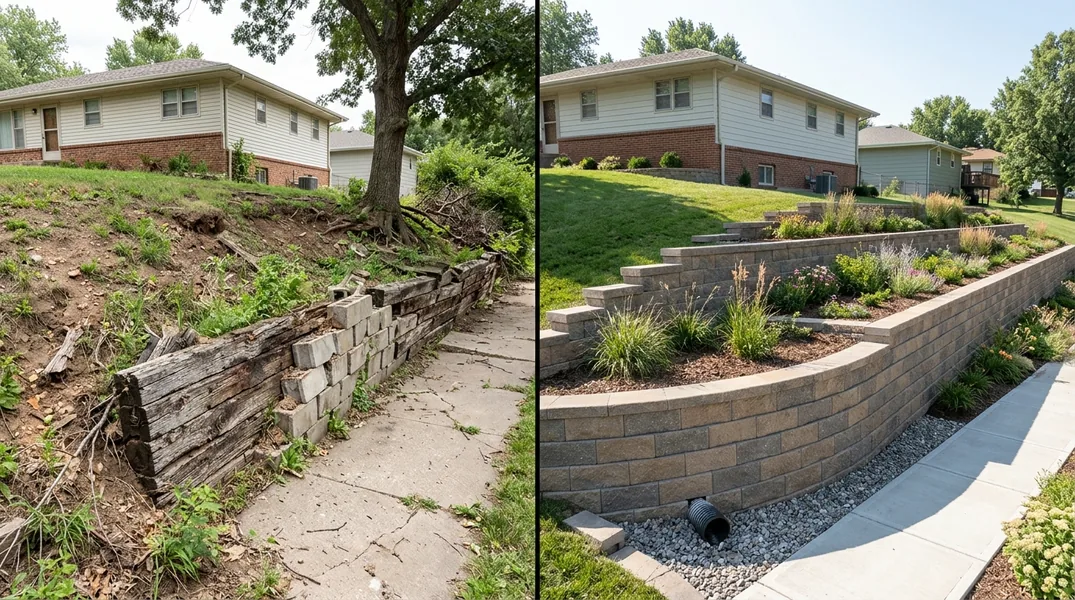
Why Wichita Soil Makes Retaining Wall Material Choice Critical
Homeowners across Wichita face a soil situation that many other parts of the country never deal with. Much of the city sits on expansive clay that swells dramatically when it absorbs water and shrinks just as aggressively when it dries out. That constant expansion and contraction pushes against anything buried in it, and a retaining wall is no exception. A wall that would perform perfectly in stable ground can crack, lean, or bow within a few seasons if the material and design do not account for that movement.
At the same time, properties near the Arkansas River and its tributaries often sit on sandy river soil, which behaves very differently. Sandy ground drains quickly but can shift and settle under load, especially when water concentrates behind a wall. The best material for your project depends on which of these conditions dominates your lot, how tall the wall needs to be, and how much water it will need to manage. Choosing a material without understanding the soil is one of the most common and most expensive mistakes homeowners make. A professional assessment before you buy a single block is worth far more than any savings from guessing.
Concrete Retaining Walls: The Heavyweight Champion for Expansive Clay
When expansive clay is the main challenge, Concrete Retaining Walls are often the strongest answer. Poured concrete is rigid, heavy, and capable of resisting the lateral pressure that swelling clay generates. Because it is installed as a continuous structure rather than stacked pieces, there are fewer joints for soil movement to exploit. For taller walls or walls holding back significant grade changes, reinforced concrete delivers a level of structural integrity that few other materials can match.
Concrete also offers design flexibility. It can be formed to follow curves, finished with textured patterns to resemble stone, and engineered with proper drainage and reinforcement for your specific soil profile. The tradeoff is that concrete requires professional forming and curing, so it is not a weekend project. It also needs correctly placed weep holes and backfill drainage to keep water from building up behind it. When those details are handled correctly, a concrete wall can serve a Wichita home for decades with minimal maintenance. If you are weighing materials for a demanding site, this is the option to discuss first with an installer who knows local soil.
Block Retaining Walls: Versatile, Attractive, and DIY-Friendly
Segmental block systems have become the most popular choice for residential retaining walls, and for good reason. Manufactured block retaining wall units interlock and often feature a pin or lip system that helps them resist shifting. They come in a wide range of colors, textures, and sizes, so you can match the look of your home or create a landscape feature that looks intentional rather than purely functional. For walls under about four feet, many block systems are designed for straightforward installation, which keeps labor costs reasonable.
That said, block walls are not immune to Wichita's soil. Expansive clay can push a poorly drained block wall out of alignment, and sandy river soil can settle beneath the base course if it is not properly compacted. The key is a correctly excavated and compacted base, generous gravel backfill, and a drainage system that moves water away from the wall. When those steps are followed, a block wall is an excellent balance of cost, appearance, and durability. Homeowners often ask whether they can build one themselves, and the honest answer is that short garden walls are feasible for a careful DIYer, while anything holding significant grade should be engineered and installed by a professional.
Boulder Retaining Walls: Natural Strength for Sandy River Soil
For properties with a natural or rustic aesthetic, a boulder retaining wall can be both beautiful and highly functional. Large, heavy boulders are difficult for soil to move, and their irregular shape allows them to interlock in ways that distribute pressure. In sandy river soil, boulders can be set with generous gravel behind them so water drains freely rather than saturating the soil and destabilizing the wall. They also handle freeze and thaw cycles well because individual stones can shift slightly without cracking.
Boulder walls do have limitations. They require careful placement by someone with equipment and experience, since a single misplaced stone can create a weak point. They also take up more footprint than a block or concrete wall of the same height, which matters on tight lots. And because they are not engineered in the same way as concrete or segmental block, very tall boulder walls may need additional reinforcement or a different approach entirely. For lower walls, garden terraces, and landscape accents, though, boulders are hard to beat for character and resilience in Wichita's variable soil.
Limestone Retaining Walls: A Regional Favorite With Real Benefits
Limestone is a familiar sight across Kansas, and a limestone retaining wall fits naturally into local landscapes. Limestone is dense and heavy, giving it good resistance to soil pressure, and its natural coloring blends well with Kansas terrain. It can be laid as stacked stone or as more formal cut blocks, depending on the look you want. Many homeowners appreciate that limestone feels authentic to the region rather than imported from a catalog.
Like any material, limestone performs best when installed with proper drainage and a stable base. It is porous compared to concrete, so in expansive clay conditions it needs a well-designed gravel backfill and weep points to prevent water from saturating the wall and the soil behind it. Limestone can also vary in quality, so sourcing from a reputable supplier matters. When installed correctly, a limestone wall offers a timeless appearance and solid structural performance. It is an especially good choice for homeowners who want a wall that looks like it belongs on the property rather than added as an afterthought.
Retaining Wall Installation Near Me: Matching Material to Your Wichita Property
There is no single best material for every property in the area. A homeowner in Derby with expansive clay and a steep grade may be best served by concrete, while someone in Andover with sandy soil and a modest slope might get everything they need from a well-built block or boulder wall. The right answer comes from evaluating your soil, drainage patterns, wall height, and the load the wall must carry. That is exactly the kind of assessment a local professional provides during a site visit.
If you are comparing materials and want a clear recommendation for your property, reach out for a free estimate or call (316) 243-1027. Wichita Retaining Wall serves homeowners throughout the area, including Haysville, and can explain how each material performs in your specific soil conditions. You can also review typical pricing to start planning your budget. Getting the material right the first time protects your investment and saves you from costly repairs later.
Looking for a professional retaining wall contractor in Wichita? Wichita Retaining Wall responds fast for all your retaining wall needs.
Get a Free QuoteOur services: Retaining Wall Installation · Retaining Wall Repair · Retaining Wall Replacement